Editorial Note: This article is for educational and informational purposes only. It explains a simple budgeting framework and how to use a calculator. It does not recommend any financial product, bank, investment, debt repayment strategy, or personal financial decision.
The 50/30/20 budget rule is a simple way to turn your monthly take-home pay into three broad spending categories: needs, wants, and savings or debt-related goals.
The main appeal is that the formula is easy to understand. Instead of tracking every dollar into dozens of categories, you start with one monthly number: your take-home pay, meaning the amount that actually reaches your bank account after payroll deductions.
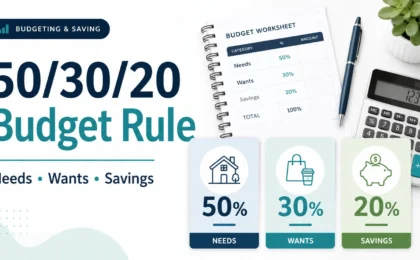
From there, the 50/30/20 rule divides that amount into three parts:
- 50% for needs: basic expenses such as housing, groceries, utilities, insurance, transportation, and required bills.
- 30% for wants: flexible spending such as dining out, streaming, hobbies, travel, entertainment, and personal upgrades.
- 20% for savings or debt-related goals: money set aside for future goals, emergency savings, or extra payments toward debt if that fits your situation.
This guide does not tell you what to cut, where to invest, or which debt to pay first. It only explains the math so you can use the 50/30/20 Budget Calculator to estimate your own monthly split.
Quick Answer
The 50/30/20 budget rule divides your monthly take-home pay into three simple buckets: 50% for needs, 30% for wants, and 20% for savings or debt-related goals.
For example, if your monthly take-home pay is $4,000, the rule would estimate $2,000 for needs, $1,200 for wants, and $800 for savings or debt-related goals.
What Is the 50/30/20 Budget Rule?
The 50/30/20 budget rule is a percentage-based budgeting method. It does not require a complex spreadsheet. It simply asks one question first:
What is your monthly take-home pay?
Once you know that number, the formula separates your money into three categories. The goal is not to make your budget perfect. The goal is to create a clear starting point so you can see whether your current spending pattern is balanced, tight, or simply different from the formula.
This is why the 50/30/20 rule works best as a planning tool, not as a strict rule for every household. A person in a high-rent city, a family with childcare costs, or someone with irregular income may see a very different split in real life.
That does not make the formula useless. It means the formula should be used as a simple benchmark, not as a personal judgment.
Simple Math
Monthly needs estimate = take-home pay × 50%
Monthly wants estimate = take-home pay × 30%
Monthly savings or debt-related goal estimate = take-home pay × 20%
Start With Take-Home Pay, Not Gross Salary
For this budgeting method, the most useful starting number is usually take-home pay. This is the amount available to spend, save, or allocate after paycheck deductions have already been taken out.
Gross salary can look larger on paper, but it may not reflect the amount you can actually use each month. A budget based on take-home pay is easier to compare with rent, groceries, utilities, subscriptions, and other real monthly expenses.
If your income changes from month to month, you can still use the same idea. Instead of entering a salary number, use a reasonable monthly take-home estimate and update it when your income changes.
Budgeting note: This article uses simplified monthly examples. Your actual numbers may be different depending on income timing, household size, local costs, insurance, payroll deductions, and required bills.
A Simple 50/30/20 Budget Example
Here is a basic example using $4,000 in monthly take-home pay.
| Category | Percentage | Monthly Amount | Example Items |
|---|---|---|---|
| Needs | 50% | $2,000 | Rent, groceries, utilities, insurance, basic transportation |
| Wants | 30% | $1,200 | Dining out, entertainment, hobbies, streaming, travel |
| Savings or debt-related goals | 20% | $800 | Emergency savings, future goals, or extra debt payments |
| Total | 100% | $4,000 | Full monthly take-home pay |
The math is simple:
- $4,000 × 0.50 = $2,000 for needs.
- $4,000 × 0.30 = $1,200 for wants.
- $4,000 × 0.20 = $800 for savings or debt-related goals.
This example does not mean every household should spend exactly these amounts. It simply shows how the formula works when applied to one monthly take-home pay number.
What Counts as a Need?
In the 50/30/20 rule, needs are the basic expenses that keep your household functioning. These are usually the bills and costs that are difficult to skip without creating an immediate problem.
Common examples include:
- Rent or mortgage payment.
- Groceries and basic household supplies.
- Utilities such as electricity, water, heating, and internet if required for work or daily life.
- Insurance premiums.
- Minimum required debt payments.
- Basic transportation costs.
- Childcare or other required household costs.
The word “need” can vary by household. For one person, a car may be optional. For another person, it may be required to get to work. The calculator can show the math, but it cannot classify every expense perfectly for every user.
Soft Finance Reminder
A budget category is not a moral label. The purpose of the 50/30/20 rule is to make your monthly numbers easier to see, not to judge what you enjoy or how your household is structured.
What Counts as a Want?
Wants are flexible expenses. These are purchases that may improve comfort, convenience, enjoyment, or lifestyle, but they are usually easier to adjust than required bills.
Examples may include:
- Restaurants, coffee shops, and takeout.
- Streaming services and entertainment.
- Hobbies and personal projects.
- Travel and weekend activities.
- Clothing beyond basic replacement needs.
- Home upgrades that are not urgent repairs.
The 50/30/20 rule does not say that wants are bad. In fact, the formula gives wants their own category. That is the point: instead of pretending enjoyment does not belong in a budget, the rule gives it a planned space.
This can make budgeting feel less restrictive. You are not building a plan that removes everything you like. You are building a plan that shows how much room your current income may leave for flexible spending.
What Goes Into the 20% Category?
The final 20% bucket is often described as savings, but many people also use it to think about extra debt payments or future goals. This may include emergency savings, a vacation fund, a down payment goal, or additional payments above required minimums.
This article does not tell you where the 20% should go. It does not tell you which account to use, which investment to buy, or which debt to pay first. Those decisions depend on personal circumstances, risk tolerance, interest rates, time horizon, and other factors that a simple article cannot evaluate for you.
For educational purposes, the 20% category simply means: money not assigned to current needs or wants.
Important limitation: A percentage-based budget can help organize your monthly numbers, but it cannot decide whether saving, investing, or making extra debt payments is appropriate for your specific situation.
Why the Rule Can Help Without Cutting Everything
Many people hear the word “budget” and think it means removing all enjoyable spending. The 50/30/20 rule is different because it includes wants as part of the plan.
Instead of saying “do not spend on restaurants” or “cancel every subscription,” the formula asks whether flexible spending fits inside the estimated 30% wants category. That creates visibility without requiring an all-or-nothing mindset.
For example, if your monthly take-home pay is $4,000, the 30% wants estimate is $1,200. That number does not tell you exactly what to buy or cancel. It simply gives you a monthly boundary to compare with your actual spending.
If your wants spending is below the estimate, your budget may already have room in that category. If it is above the estimate, the calculator gives you a clear number to review. The choice of what to adjust, if anything, remains yours.
Budget Calculator
Turn your take-home pay into a simple monthly split.
Use the 50/30/20 Budget Calculator to estimate how much of your monthly take-home pay would fall into needs, wants, and savings or debt-related goals.
Use the 50/30/20 Budget CalculatorHow to Use the 50/30/20 Budget Calculator
The calculator is designed to do the percentage math for you. You only need to enter your monthly take-home pay.
Step 1: Enter your monthly take-home pay
Use the amount you actually receive during the month. If you are paid every two weeks, you may estimate your average monthly take-home pay or use a recent month as a starting point.
Step 2: Review the three estimated categories
The calculator will split your number into 50%, 30%, and 20% estimates. These are not commands. They are reference points.
Step 3: Compare the estimate with your real spending
Look at your actual monthly bills and spending. Compare those numbers with the calculator output. The difference between the estimate and your real spending can show which category is taking the most space.
Step 4: Use the result as a planning snapshot
A calculator result is not a personal financial plan. It is a snapshot of how one budgeting formula would divide your income.
What If Your Budget Does Not Match 50/30/20?
Many real budgets do not match the formula perfectly. That is normal.
Housing costs may be higher than 50% in some areas. Childcare, medical costs, transportation, or insurance may push the needs category above the formula. Irregular income can also make a clean monthly split difficult.
The useful question is not “Did I pass or fail the rule?” The useful question is:
What does this formula reveal about where my take-home pay is going?
If the numbers do not fit, the calculator still gives you a starting point for review. You can see which category is larger than expected and decide whether that matters for your own situation.
What the Calculator Cannot Tell You
The calculator cannot tell you which bills to change, which debts to prioritize, where to invest, or whether a purchase is right for you. It only applies a simple percentage formula to the income number you enter.
A Second Example: $5,500 Monthly Take-Home Pay
Here is another example using $5,500 in monthly take-home pay.
| Category | Formula | Estimated Amount |
|---|---|---|
| Needs | $5,500 × 50% | $2,750 |
| Wants | $5,500 × 30% | $1,650 |
| Savings or debt-related goals | $5,500 × 20% | $1,100 |
| Total | 100% | $5,500 |
This second example shows why the formula is easy to scale. Whether your take-home pay is $3,000, $4,000, $5,500, or another amount, the calculator applies the same percentages.
When the 50/30/20 Rule Is Most Useful
The 50/30/20 rule may be useful when you want a simple overview rather than a detailed line-by-line budget.
It can help you:
- Estimate a simple monthly budget from take-home pay.
- Separate required expenses from flexible spending.
- See whether wants have a planned place in your budget.
- Compare your real spending with a basic percentage framework.
- Create a starting point before building a more detailed budget.
For additional general budgeting education, public resources such as the Consumer Financial Protection Bureau and MyMoney.gov provide worksheets, spending trackers, and financial education tools. These resources can be useful for learning, but your own budget still depends on your numbers.
Common Mistakes When Using the 50/30/20 Rule
Mistake 1: Using gross salary instead of take-home pay
If you use gross salary, your budget may look larger than the money you actually receive. For this simple formula, take-home pay usually gives a clearer monthly picture.
Mistake 2: Treating the percentages as strict rules
The 50/30/20 split is a framework. It may not match every household, city, income level, or life stage.
Mistake 3: Forgetting irregular expenses
Some costs do not happen every month. Annual insurance premiums, car repairs, school costs, holiday spending, and medical expenses may not appear in a normal monthly snapshot unless you plan for them separately.
Mistake 4: Thinking the rule makes personal decisions for you
The formula does not know your household priorities. It does not know your risk tolerance, family obligations, location, health costs, job stability, or future goals. It only divides one income number into three percentages.
Final Takeaway
The 50/30/20 budget rule is useful because it is simple. Start with monthly take-home pay, then estimate 50% for needs, 30% for wants, and 20% for savings or debt-related goals.
The rule does not require you to remove everything you enjoy. It gives wants a visible place in the budget while still showing how much may be left for future goals.
The safest way to use this rule is as a calculator-based planning tool. Enter your own take-home pay, review the estimated categories, and compare the result with your real monthly spending.
Bottom line: the 50/30/20 rule does not make financial decisions for you. It simply gives you a clear monthly framework so you can understand your own numbers more easily.
Next Step
Calculate your own 50/30/20 budget split.
Enter your monthly take-home pay and see how the 50/30/20 formula divides it into needs, wants, and savings or debt-related goals.
Open the 50/30/20 Budget CalculatorFAQ
What is the 50/30/20 budget rule?
The 50/30/20 budget rule is a simple budgeting framework that divides monthly take-home pay into three broad categories: 50% for needs, 30% for wants, and 20% for savings or debt-related goals. It is a planning tool, not personalized financial advice.
Should I use gross income or take-home pay for the 50/30/20 rule?
For a simple monthly budget, take-home pay is usually easier to use because it represents the money actually available after paycheck deductions. Gross income may not match the amount available for monthly expenses.
What if my needs are more than 50% of my income?
Many real budgets do not match the formula perfectly. Housing, childcare, transportation, insurance, medical costs, or local cost of living can push needs above 50%. The rule is best used as a benchmark to review your numbers, not as a pass-or-fail test.
Does the 50/30/20 rule tell me which debt to pay first?
No. The 50/30/20 rule does not decide which debt to prioritize. It only estimates how much of take-home pay would fall into broad categories. Debt repayment decisions depend on personal circumstances and should not be based only on this formula.
Does the 20% category tell me where to invest?
No. The 20% category may represent savings, future goals, or debt-related goals, but it does not recommend any investment, account, bank, product, or strategy. The calculator only shows the percentage math.
Can I use the 50/30/20 rule if I am paid weekly or bi-weekly?
Yes. You can estimate your monthly take-home pay based on your pay schedule, then apply the same 50%, 30%, and 20% formula. The result is still an estimate and should be compared with your real monthly expenses.
Does the 50/30/20 rule mean I should stop spending on wants?
No. The formula includes a wants category on purpose. It does not say that flexible spending is bad. It simply gives wants a planned place in the monthly budget.
Disclaimer & Editorial Disclosure
Informational Purposes Only: This content and the attached calculators are for educational and informational purposes only. They do not constitute financial, investment, tax, legal, banking, credit, debt repayment, or career advice. All examples are hypothetical and simplified for learning purposes.
No Individual Recommendation: The 50/30/20 Budget Calculator applies a basic percentage formula to the numbers you enter. It does not evaluate your full financial situation, recommend where to save, suggest which debts to pay first, or determine whether any purchase or financial decision is appropriate for you.
Editorial Note: Wealth Logic Hub publishes educational content and calculator-based resources. References to budgeting concepts are provided for general information only and should not be treated as personalized financial guidance.