Introduction: Beyond Rewards Points
While most consumers view credit cards through the lens of travel perks and cashback, the ultra-high-net-worth (UHNW) individual and the sophisticated business owner see a different landscape: The Arbitrage Opportunity. In 2026, where liquidity is king, mastering the spread between credit costs and investment returns is the ultimate financial lever.
The Mechanics of Credit Arbitrage
Credit Arbitrage in the corporate world isn’t about debt; it’s about timing and cost of capital. This strategy involves leveraging 0% introductory APR periods on business cards to fund short-term revenue-generating operations, effectively using the bank’s money as interest-free venture capital.
- The 0% APR Bridge: Using high-limit business cards (e.g., Ink Business or Amex Blue Business Plus) to cover inventory or payroll during scaling phases.
- Capital Preservation: Keeping your liquid cash in High-Yield Cash Management accounts (earning 4-5%+) while utilizing the bank’s float for 12–18 months.
Strategic Tax Deductibility of Transaction Fees
A “Gold Level” secret often overlooked is the tax treatment of credit card processing fees in a business context. When structured correctly, the costs associated with “Plastiq-style” payments for non-cardable expenses (like rent or raw materials) are fully deductible business expenses, while the points generated remain tax-free wealth.
The “Shadow Limit” and Debt-to-Income Isolation
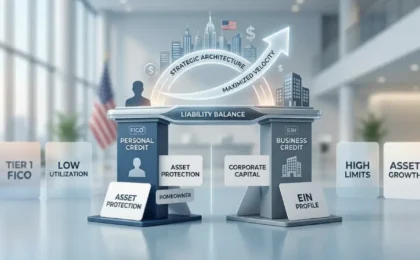
One of the most critical architectures for 2026 is the Total Isolation Strategy. By utilizing Tier-1 Business Credit that does not report to personal credit bureaus, the sophisticated borrower maintains a “clean” personal DTI (Debt-to-Income) ratio.
- The Benefit: This allows for simultaneous high-leverage business maneuvers while remaining “mortgage-ready” for luxury real estate acquisitions.
Advanced Point Valuation: The Yield on Spend (YOS)
Stop measuring ROI; start measuring Yield on Spend (YOS).
Formula: (Value of Rewards – Fees) / Total Spend = YOS
In 2026, an optimized “Trifecta” combined with strategic transfer partners for international first-class suites can result in a YOS of over 12%, effectively acting as a silent dividend on every dollar your business spends.
Risk Mitigation in a Volatile Market
- The Velocity Rule: Never scale spend faster than your 90-day liquidity can cover.
- The Exit Strategy: Always have a dedicated “liquidation fund” or a pre-approved SBA line of credit to bridge the end of a 0% APR period.
Conclusion
The shift from “using credit” to “architecting credit” is what separates the affluent from the wealthy. In 2026, your credit portfolio should be managed with the same rigor as your stock or real estate portfolio—as a dynamic asset designed for maximum liquidity and zero-cost scaling.

Related articles
Mastering Velocity Banking: Using Strategic Credit Lines to Accelerate Debt Liquidation

Mastering the Tier-1 Ecosystem: A Strategic Guide to Credit Sequencing in 2026

The Power of the Trifecta: Engineered Spending for Maximum Yield