Editorial Note: The content of this article is based on the author’s opinions and recommendations alone. It has not been previewed, commissioned, or otherwise endorsed by any bank, credit card issuer, advertiser, or financial partner.
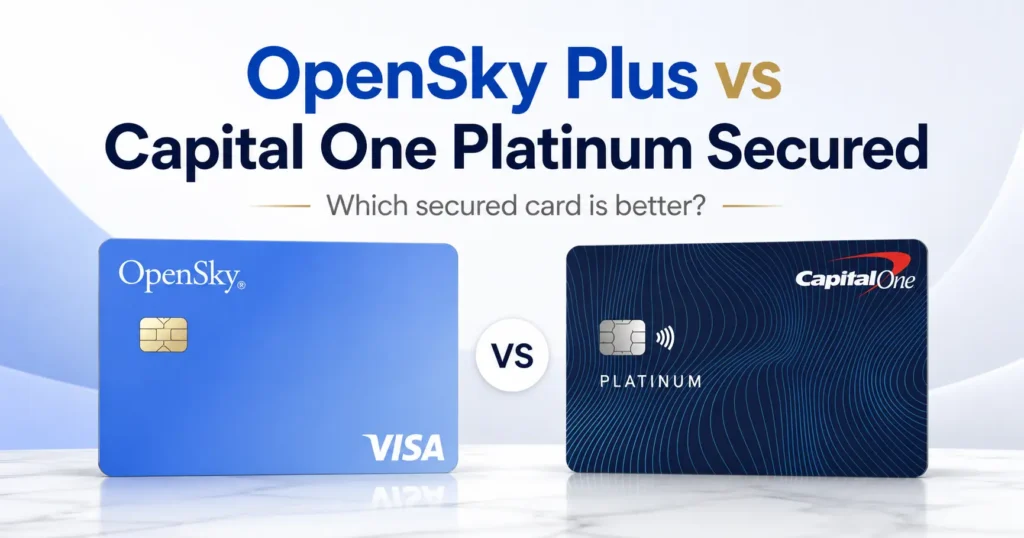
OpenSky Plus vs Capital One Platinum Secured is one of the most important comparisons for people who want to build or rebuild credit with a secured credit card in 2026. Both cards are designed for consumers with limited, damaged, or rebuilding credit, but they solve different problems.
The OpenSky® Plus Secured Visa® Credit Card is built around access: no credit check to apply, no annual fee, and a deposit-backed credit line. The Capital One Platinum Secured Credit Card is built around flexibility: a potentially lower refundable deposit, a major-bank ecosystem, and a clearer path toward getting your deposit back with responsible use.
Quick Verdict
Go with OpenSky Plus if your main priority is avoiding a credit check. It is the better fit if you have been denied by traditional issuers, want to avoid a hard inquiry, or need a secured card that does not rely on a standard credit review to apply.
Go with Capital One Platinum Secured if your main priority is a lower possible deposit and a stronger long-term upgrade path. Some approved applicants may open a $200 initial credit line with a refundable deposit of $49, $99, or $200.
Best overall for most rebuilders: Capital One Platinum Secured, because of its lower potential entry cost and clearer path to getting your deposit back. Best for no-credit-check access: OpenSky Plus.
OpenSky Plus vs Capital One Platinum Secured: Side-by-Side Comparison
The biggest mistake is treating these two cards as interchangeable. They are both secured credit cards, but the approval process, deposit structure, and long-term path are very different.
| Feature | OpenSky® Plus Secured Visa® | Capital One Platinum Secured | Winner |
|---|---|---|---|
| Best For | No-credit-check secured card access | Low-deposit secured card access | Depends on your problem |
| Credit Check | No credit check to apply | Pre-approval may not affect your score, but a full application can involve a hard inquiry | OpenSky Plus |
| Minimum Deposit | $300 | $49, $99, or $200, depending on approval | Capital One |
| Initial Credit Line | Your deposit generally supports your credit line | At least $200 after the required deposit is completed | Capital One |
| Annual Fee | $0 | $0 | Tie |
| Rewards | No traditional rewards program | No rewards program | Tie |
| Credit Bureau Reporting | Reports to the three major credit bureaus | Reports to the three major credit bureaus | Tie |
| Graduation / Deposit Return Path | Less clearly positioned around automatic graduation | Clearer path toward deposit return, credit line reviews, and possible unsecured upgrade | Capital One |
| Best Use Case | When avoiding a credit check matters most | When lowering upfront cash and building toward unsecured credit matters most | Capital One for most users |
Credit-building note: Neither card can guarantee a higher credit score. A secured card can help only when the account is used responsibly: pay on time, keep utilization low, avoid unnecessary debt, and monitor your credit reports.
What Is the OpenSky Plus Secured Visa?
The OpenSky Plus Secured Visa Credit Card is a secured credit card designed for people who want access to credit without a traditional credit check during the application process.
That is the card’s main advantage. If you have a thin file, past denials, damaged credit, or fear that another inquiry could hurt your score further, OpenSky Plus is easier to understand than many bank-issued secured cards.
The trade-off is the deposit requirement. OpenSky Plus requires a minimum refundable security deposit of $300. Your deposit generally supports your credit line, which means a $300 deposit gives you a $300 spending limit.
OpenSky Plus is best for people who:
- Want a secured credit card with no credit check to apply.
- Have been denied by traditional card issuers.
- Have damaged credit or no credit history.
- Can afford the $300 minimum refundable security deposit.
- Want a card that reports to Equifax, Experian, and TransUnion.
- Do not need rewards, cash back, or travel benefits.
OpenSky Plus may not be ideal if:
- You cannot afford to lock up $300 as a deposit.
- You want the lowest possible upfront cost.
- You want a clear path to graduate to an unsecured card.
- You plan to carry a balance.
- You already qualify for a no-annual-fee unsecured credit card.
What Is the Capital One Platinum Secured Credit Card?
The Capital One Platinum Secured Credit Card is a secured credit card from a major U.S. issuer. Its main advantage is not rewards or premium perks. Its main advantage is the flexible security deposit.
Depending on Capital One’s review, approved applicants may receive a $200 initial credit line with a refundable deposit of $49, $99, or $200. That can make the card much easier to open than secured cards that require the full credit limit upfront.
Capital One also gives cardholders a clearer long-term path than many secured cards. With responsible use, users may be considered for credit line increases, deposit return, or an upgrade toward unsecured credit.
Capital One Platinum Secured is best for people who:
- Want a secured card with no annual fee.
- Want a chance at a lower refundable deposit.
- Prefer a major-bank credit card ecosystem.
- Want a clearer path toward deposit return.
- Can use the card responsibly for several months.
- Want automatic account reviews over time.
Capital One Platinum Secured may not be ideal if:
- You want to avoid a credit check completely.
- You need guaranteed approval.
- You want rewards while building credit.
- You plan to carry a balance.
- You need a guaranteed $49 deposit.
Round 1: Credit Check and Approval Odds
This is the most important difference in the OpenSky Plus vs Capital One Platinum Secured comparison.
OpenSky Plus does not require a credit check to apply. That makes it attractive for consumers who are worried about a hard inquiry, have been denied before, or do not want another application showing up on their credit report.
Capital One works differently. Capital One allows you to check for pre-approval with no risk to your credit score, but a full application may still involve a hard inquiry. That is normal for traditional credit card applications, but it matters if you are trying to avoid new inquiries.
Winner for no credit check: OpenSky Plus. If avoiding a credit check is your top priority, OpenSky is the cleaner choice.
However, no credit check does not mean guaranteed approval. OpenSky may still deny an application if the applicant does not meet identity, income, residency, fraud prevention, or other issuer requirements.
Capital One may also deny an application. The difference is that Capital One is more likely to evaluate your broader credit and financial profile before approval.
For background, the Consumer Financial Protection Bureau explains that a hard inquiry can appear when a lender checks your credit report after you apply for credit, while soft inquiries are generally used for checks that do not affect your score.
Round 2: Security Deposits and Credit Limits
This is where Capital One becomes more competitive.
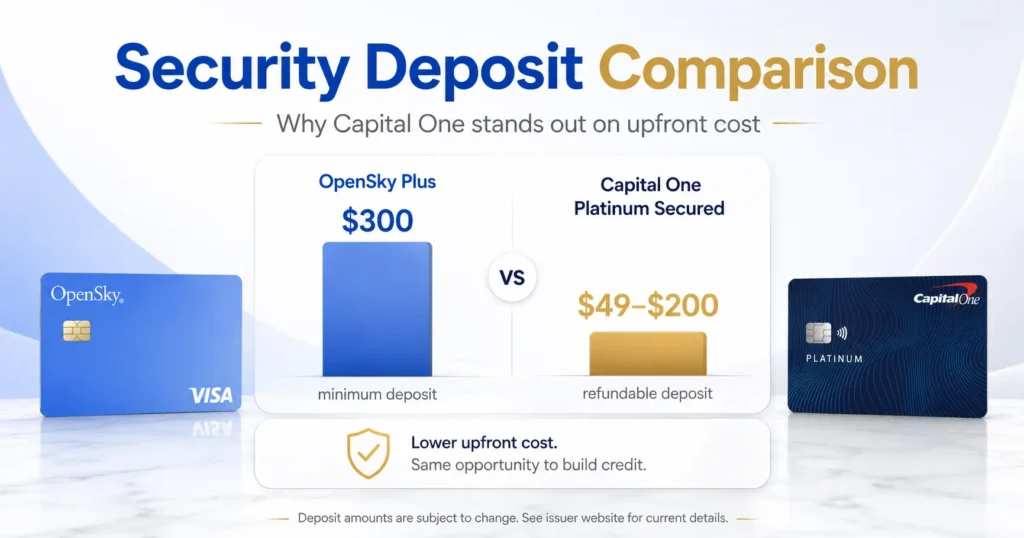
OpenSky Plus uses a simple deposit structure. Your deposit generally supports your credit line. If you deposit $300, your credit line is generally $300. If you deposit more, your credit limit may be higher, subject to issuer approval and maximum limits.
This structure is easy to understand, but it ties up more cash upfront. For someone rebuilding credit on a tight budget, $300 can be a real obstacle.
Capital One Platinum Secured may require less cash upfront. Some approved applicants may open a $200 initial credit line with a refundable deposit of $49, $99, or $200. That is the main reason Capital One is often more attractive for budget-conscious rebuilders.
| Scenario | OpenSky Plus | Capital One Platinum Secured |
|---|---|---|
| You only have $50 available for a deposit | Not enough for the $300 minimum deposit | Potentially enough if approved for the $49 deposit tier |
| You have $200 available | Still below the $300 minimum deposit | May be enough to open the account if approved |
| You have $300 available | Meets the minimum deposit | May be more than required, depending on approval |
| You want a simple deposit-to-limit structure | Stronger fit | Less predictable until Capital One assigns your required deposit |
Winner for deposit flexibility: Capital One Platinum Secured. The possibility of a $49 or $99 refundable deposit for a $200 initial credit line is a major advantage.
Round 3: Annual Fees and Ongoing Costs
Both cards have a $0 annual fee. That is important because a credit-building card should not be expensive to keep open.
However, “no annual fee” does not mean “free to use irresponsibly.” Both cards may have high APRs. If you carry a balance, interest charges can quickly make either card expensive.
OpenSky Plus lists a high variable APR. Capital One Platinum Secured also generally carries a high APR compared with prime rewards cards. In both cases, the correct strategy is to use the card for small purchases and pay the full statement balance every month.
Costs to check before applying:
- Regular purchase APR.
- Late payment fees.
- Returned payment fees.
- Foreign transaction fees, if applicable.
- Balance transfer terms, if available.
- Cash advance fees and APR.
Before applying for any secured card, review the issuer’s current pricing, fees, and disclosures. You can also use CFPB’s credit reports and scores resources to better understand how credit activity may affect your financial profile.
Winner for annual fee: Tie. Both cards have no annual fee. The real difference is not the annual fee; it is the deposit requirement and upgrade path.
Round 4: Graduation Path and Deposit Return
This is the factor many people overlook.
A secured card should ideally be temporary. The goal is not to keep a deposit-backed card forever. The goal is to build enough positive history to qualify for a better card, receive your deposit back, or move into an unsecured credit product.
Capital One has the clearer long-term structure. With responsible use, cardholders may be considered for a higher credit line, deposit return, or an upgrade toward unsecured credit.
OpenSky Plus is different. OpenSky can help with credit-building because it reports to the major credit bureaus, but the Plus card is not as clearly positioned around automatic graduation. That does not make it bad. It simply means you should choose OpenSky mainly for no-credit-check access, not because you expect a fast upgrade.
Winner for graduation path: Capital One Platinum Secured. If your goal is to move toward an unsecured card and get your deposit back, Capital One has the stronger long-term structure.
Round 5: Credit Bureau Reporting
Both cards can help build credit because both report account activity to the major consumer credit bureaus.
That reporting is what gives a secured credit card its credit-building potential. If the issuer reports on-time payments and responsible account use, your credit file may improve over time. If it reports late payments or high utilization, your credit can be damaged.
For best results, do not use the full limit. A $300 credit limit can be maxed out quickly, and high utilization may hurt your score even if you pay on time.
A safer credit-building routine:
- Use the card for one or two small recurring purchases.
- Keep the balance well below the credit limit.
- Pay before the due date every month.
- Consider paying before the statement closes to reduce reported utilization.
- Do not carry a balance to “build credit.” Interest is not required.
- Review your credit reports regularly through AnnualCreditReport.com, the official site for free credit reports from Equifax, Experian, and TransUnion.
Winner for credit reporting: Tie. Both cards can support credit-building if used responsibly.
If you are rebuilding credit, it is also useful to understand how scoring works. myFICO explains that a FICO Score is based on information in your credit reports and helps lenders estimate how likely you are to repay debt.
OpenSky Plus Pros and Cons
Pros
- No credit check to apply.
- No hard pull required for the application process.
- $0 annual fee.
- Reports to the three major credit bureaus.
- Useful for consumers with past denials or damaged credit.
- Simple deposit-backed credit limit structure.
- Visa acceptance is broad in the U.S.
Cons
- $300 minimum refundable security deposit.
- Your deposit generally supports your credit line.
- High variable APR.
- No traditional rewards program.
- No clearly defined automatic graduation path.
- Not ideal if you plan to carry a balance.
Capital One Platinum Secured Pros and Cons
Pros
- $0 annual fee.
- Potentially low refundable deposit of $49, $99, or $200.
- Initial credit line of at least $200 after the required deposit is made.
- Issued by a major U.S. bank.
- Possible credit line reviews with responsible use.
- Potential path to deposit return and upgrade to an unsecured card.
- Reports to the major credit bureaus.
Cons
- No rewards program.
- Approval is not guaranteed.
- The lowest deposit amount is not guaranteed.
- A full application may involve a hard inquiry.
- High APR if you carry a balance.
- Not the best fit if avoiding a credit check is your main goal.
Who Should Choose OpenSky Plus?
Choose OpenSky Plus if your biggest concern is the credit check itself.
This card is especially useful if you are worried that a traditional bank application will lead to another denial or another hard inquiry. It can also make sense if your credit file is thin, damaged, or difficult for standard issuers to evaluate.
OpenSky Plus is not the cheapest secured card to open because of the $300 minimum deposit. But it may be the more accessible card if you are prioritizing application access over deposit flexibility.
OpenSky Plus is the better choice if:
- You want no credit check to apply.
- You have been denied for secured cards from major banks.
- You can afford the $300 minimum deposit.
- You want a straightforward Visa secured card.
- You are not focused on rewards or fast graduation.
For a deeper breakdown, read our full OpenSky Plus Secured Visa Credit Card review.
Who Should Choose Capital One Platinum Secured?
Choose Capital One Platinum Secured if your main concern is upfront cost and long-term progression.
The possibility of opening a $200 initial credit line with a $49 or $99 refundable deposit is a major advantage. That can make Capital One more practical if you are rebuilding credit but do not want to lock up a full $300 or more.
Capital One also has the stronger path if your goal is to eventually move beyond secured credit. The possibility of deposit return, credit line reviews, and upgrade toward unsecured credit makes it more attractive for disciplined users.
Capital One Platinum Secured is the better choice if:
- You want the lowest possible deposit requirement.
- You are comfortable with a traditional card application.
- You want a major-bank secured card.
- You want a clearer path toward deposit return.
- You are willing to use the card responsibly for several months.
For a full breakdown, read our Capital One Platinum Secured Credit Card review.
Which Card Builds Credit Better?
Neither card automatically builds credit just because you are approved. Credit-building depends on how the account is reported and how you manage it.
Both cards can help if they are used correctly. The key factors are payment history, utilization, account age, and responsible use over time.
OpenSky Plus may be better if you would otherwise avoid applying for a card because of the credit check. Capital One may be better if you want a card that can grow with you through credit line reviews and a possible unsecured upgrade.
The practical answer:
- Best for access: OpenSky Plus.
- Best for lower deposit: Capital One Platinum Secured.
- Best for long-term progression: Capital One Platinum Secured.
- Best if you have repeated denials: OpenSky Plus.
- Best for most rebuilders: Capital One Platinum Secured.
If you are still comparing starter cards, also read our guide to the best credit cards for building credit.
Common Mistakes to Avoid With Either Card
The card you choose matters, but your habits matter more. A secured credit card can help or hurt depending on how you use it.
1. Carrying a balance
You do not need to carry a balance to build credit. Carrying a balance usually means paying interest, and these cards are not designed for low-cost borrowing.
2. Using too much of the limit
A low credit limit can create high utilization quickly. If your limit is $300 and your statement reports a $250 balance, your utilization is very high even if you plan to pay it off later.
3. Missing a payment
Payment history is one of the most important credit factors. A late payment can erase months of progress.
4. Applying for too many cards at once
Multiple applications can create unnecessary inquiries and denials. Build a sequence instead of applying randomly.
For a smarter path, read our guide to credit card sequencing.
Best Alternatives to Consider
OpenSky Plus and Capital One Platinum Secured are not the only options. Depending on your situation, one of these alternatives may be a better fit.
| Alternative | Best For | Why Compare It? |
|---|---|---|
| Discover it® Secured Credit Card | Rewards while building credit | Discover may be better if you want cash back while rebuilding. |
| Chime Credit Builder Card | No interest and no traditional credit card APR | Chime works differently from a secured credit card and may be safer for users who want to avoid debt. |
| Credit Cards for Building Credit | Broader comparison | Useful if you want to compare secured cards, student cards, and credit-builder products together. |
Final Verdict: OpenSky Plus vs Capital One Platinum Secured
The winner depends on why you are looking for a secured credit card.
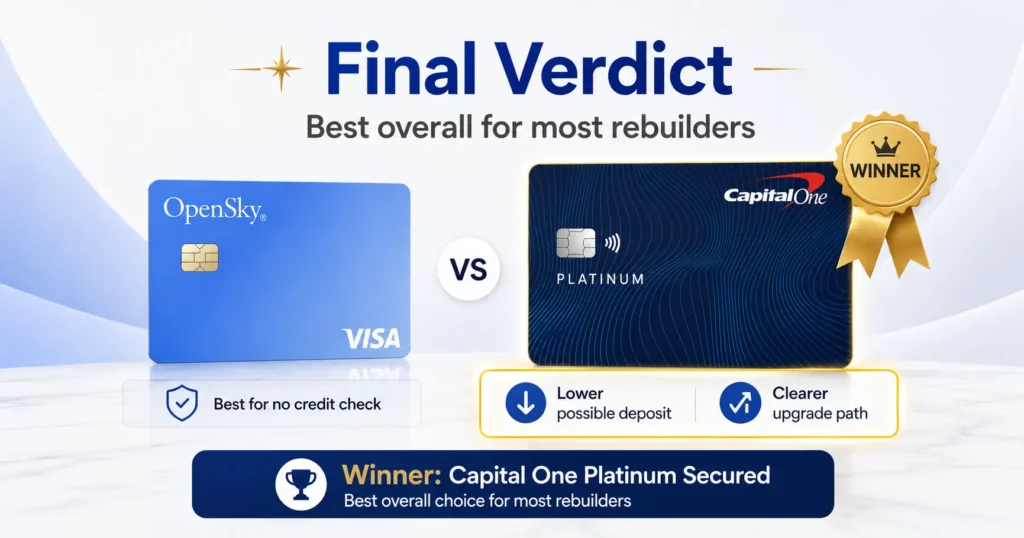
If you want the easiest application path without a credit check, OpenSky Plus is the stronger choice. It gives people with difficult credit histories a practical way to access a secured Visa card, provided they can afford the $300 minimum deposit.
If you want the better overall secured card for most rebuilders, Capital One Platinum Secured is the stronger choice. The flexible deposit structure, potential credit line reviews, and clearer path to deposit return make it more attractive for long-term credit-building.
Bottom Line
Choose OpenSky Plus if avoiding a credit check matters more than the deposit amount.
Choose Capital One Platinum Secured if you want a lower possible deposit, a major-bank issuer, and a better chance to move toward unsecured credit later.
FAQ
Does OpenSky do a hard pull?
No. OpenSky states that the OpenSky Plus Secured Visa does not require a credit check to apply. That means there is no traditional hard pull for the application.
How long does it take for Capital One secured to graduate?
Capital One may review responsible accounts for credit line increases, deposit return, or an upgrade toward unsecured credit. Timing is not guaranteed, but users may be considered for credit line increases in as little as six months.
Can you be denied for an OpenSky card?
Yes. No credit check does not mean guaranteed approval. OpenSky may still deny an application based on identity, income, residency, fraud prevention, account history, or other eligibility requirements.
Is OpenSky Plus better than Capital One Platinum Secured?
OpenSky Plus is better if you want no credit check to apply. Capital One Platinum Secured is better for most users who want a lower possible deposit and a stronger long-term path toward unsecured credit.
Which card has the lower deposit?
Capital One Platinum Secured may have the lower deposit. Some approved applicants may receive a $200 initial credit line with a refundable deposit of $49, $99, or $200, while OpenSky Plus has a $300 minimum deposit.
Do both cards report to the credit bureaus?
Yes. Both cards report account activity to the major credit bureaus. On-time payments and low utilization may help build credit, while missed payments or high balances can hurt your credit.
Do you need to carry a balance to build credit?
No. You do not need to carry a balance or pay interest to build credit. Paying the full statement balance on time is usually the safer strategy.
Which card is better after a credit denial?
OpenSky Plus may be better after repeated denials because it does not require a credit check to apply. However, approval is still not guaranteed.
Disclaimer & Editorial Disclosure
Informational Purposes Only: The information provided on Wealth Logic Hub is for educational and informational purposes only and does not constitute financial, legal, tax, credit, or investment advice. Credit card terms, fees, APRs, rewards, security deposit rules, approval standards, credit reporting practices, and upgrade policies can change. Always review the issuer’s official terms before applying.
Advertiser Disclosure: Wealth Logic Hub is an independent, advertising-supported publisher and comparison service. We may receive compensation from credit card issuers, financial companies, or partners whose products appear on this site. This compensation may affect how and where products appear, including the order in which they are displayed. Wealth Logic Hub does not include all credit card companies, financial institutions, or available card offers in the marketplace.
Editorial Note: Opinions, reviews, ratings, and card evaluations expressed in this article are the author’s alone and have not been reviewed, approved, or otherwise endorsed by any bank, credit card issuer, advertiser, or financial partner.