Editorial Note: This article is for educational and informational purposes only. It explains the basic math behind estimating an emergency fund target. It does not recommend any bank, brokerage, account, financial product, debt repayment decision, or personal financial strategy.
An emergency fund is money set aside for unexpected expenses or income disruptions. The purpose is simple: to create a financial cushion for costs that are urgent, unplanned, and difficult to avoid.
The math behind an emergency fund is usually simple. Start with your essential monthly expenses, then multiply that number by a target number of months. Many educational examples use three to six months as a basic range.
For example, if your essential monthly expenses are $2,500, a three-month emergency fund target would be $7,500. A six-month target would be $15,000.
This guide does not tell you where to keep the money, which account to use, or whether to use emergency savings for debt. It only explains how to calculate a target number using the Emergency Fund Target Calculator.
Quick Answer
An emergency fund target is usually estimated by multiplying essential monthly expenses by a number of months.
A simple formula is: essential monthly expenses × 3 months for a smaller target, or essential monthly expenses × 6 months for a larger target.
What Is an Emergency Fund?
An emergency fund is a reserve of money set aside for unexpected financial events. These events are usually not part of normal monthly spending.
Common examples may include:
- Unexpected medical bills.
- Temporary loss of income.
- Urgent car repairs needed for work or daily transportation.
- Necessary home repairs.
- Essential travel caused by a family emergency.
The key word is unexpected. An emergency fund is not the same as a vacation fund, holiday shopping fund, home upgrade fund, or entertainment budget.
A planned purchase may still be important, but it is not usually an emergency if it can be scheduled, delayed, or saved for separately.
Simple distinction: An emergency fund is for unplanned needs, not planned wants.
The Basic Emergency Fund Formula
The simplest emergency fund formula is:
Simple Math
Emergency fund target = essential monthly expenses × number of months
Example: $2,500 essential monthly expenses × 6 months = $15,000 emergency fund target.
This formula is intentionally simple. It does not predict the future. It does not know whether an emergency will happen, how much it will cost, or how long an income disruption could last. It only creates a planning number based on your essential monthly expenses.
The most important input is your essential monthly expenses. This is different from your total monthly spending. Essential expenses usually include the basic costs required to keep your household operating.
What Counts as an Essential Monthly Expense?
Essential monthly expenses are the costs you would likely need to cover even during a financial emergency. These are usually different from optional or flexible purchases.
Common essential expenses may include:
- Rent or mortgage payment.
- Groceries and basic household supplies.
- Utilities such as electricity, water, heating, and basic internet access.
- Insurance premiums.
- Minimum required debt payments.
- Basic transportation costs.
- Childcare or dependent care if required.
- Necessary medical costs and prescriptions.
Essential expenses are not the same for everyone. A car payment may be essential for someone who must drive to work. For another person with reliable public transportation, it may not play the same role. The calculator can help with the math, but it cannot classify every expense perfectly for every household.
Soft Finance Reminder
The goal is not to label every purchase as good or bad. The goal is to separate basic survival costs from flexible spending so the emergency fund target is based on realistic monthly needs.
Emergency vs. Want: A Simple Difference
One useful way to understand an emergency fund is to separate real emergencies from wants.
A real emergency is usually urgent, unexpected, and connected to health, housing, transportation, income, safety, or basic household stability.
A want may be enjoyable or useful, but it is usually planned, optional, or delayable.
| Situation | Emergency? | Why |
|---|---|---|
| Unexpected medical bill | Usually yes | It may be urgent and necessary. |
| Temporary job loss | Usually yes | Income may stop while essential bills continue. |
| Car repair needed to get to work | Often yes | Transportation may be required for income or daily life. |
| Buying a larger TV | Usually no | It is generally a planned or optional purchase. |
| Weekend trip | Usually no | It may be enjoyable, but it can usually be planned separately. |
This distinction matters because an emergency fund target is based on essential survival costs, not the full cost of maintaining every normal lifestyle expense during a disruption.
How to Calculate a Three-Month Emergency Fund
A three-month emergency fund estimate multiplies essential monthly expenses by three.
For example, assume your essential monthly expenses are $2,500:
- $2,500 × 3 months = $7,500.
In this simplified example, the three-month emergency fund target is $7,500.
This does not mean $7,500 is the right number for every person. It only shows how the formula works when applied to one monthly expense number.
How to Calculate a Six-Month Emergency Fund
A six-month emergency fund estimate multiplies essential monthly expenses by six.
Using the same $2,500 monthly essential expense example:
- $2,500 × 6 months = $15,000.
In this simplified example, the six-month emergency fund target is $15,000.
The six-month target is larger because it assumes more time may be needed to cover essential expenses. The calculator can show both numbers so you can compare the difference without doing the math manually.
Emergency Fund Calculator
Estimate your emergency fund target with simple math.
Use the Emergency Fund Target Calculator to multiply your essential monthly expenses by three, six, or another month target.
Use the Emergency Fund Target CalculatorExample Emergency Fund Targets
The table below shows how the same formula works with different essential monthly expense amounts.
| Essential Monthly Expenses | 3-Month Target | 6-Month Target |
|---|---|---|
| $1,500 | $4,500 | $9,000 |
| $2,000 | $6,000 | $12,000 |
| $2,500 | $7,500 | $15,000 |
| $3,000 | $9,000 | $18,000 |
| $4,000 | $12,000 | $24,000 |
These are educational examples only. Your own emergency fund target depends on your actual essential expenses and the number of months you want to estimate.
How the Emergency Fund Target Calculator Works
The Emergency Fund Target Calculator automates the multiplication step. Instead of calculating each scenario manually, you enter your essential monthly expenses and choose the number of months you want to estimate.
Step 1: Add your essential monthly expenses
Start with the basic expenses you would need to keep paying during an emergency. This may include housing, groceries, utilities, insurance, minimum required payments, transportation, and necessary medical costs.
Step 2: Select a month target
Common educational examples use three months or six months. The calculator can show how the target changes when the number of months changes.
Step 3: Review the estimated target
The calculator multiplies your essential monthly expenses by the selected number of months. The result is your estimated emergency fund target.
Step 4: Compare the result with your current savings
If you enter your current emergency savings, the calculator may also help show the gap between what you have now and the target amount. This is still only a math estimate, not a personal recommendation.
What the Calculator Cannot Tell You
The calculator cannot tell you where to keep emergency savings, which bank to use, whether to use the money for debt, or what target is best for your full financial situation. It only applies the emergency fund formula to the numbers you enter.
Why Essential Expenses Matter More Than Total Spending
If you use total monthly spending, your emergency fund target may become larger than necessary for a basic emergency estimate. Total spending may include restaurants, subscriptions, shopping, travel, entertainment, and other flexible costs.
Those expenses may be part of normal life, but they are not always required during an emergency. This is why many emergency fund calculations focus on essential expenses first.
For example, assume a household spends $4,200 per month in total, but only $2,800 of that amount is essential. Using total spending would create a six-month target of $25,200. Using essential expenses would create a six-month target of $16,800.
| Input Used | Monthly Amount | 6-Month Target |
|---|---|---|
| Total monthly spending | $4,200 | $25,200 |
| Essential monthly expenses | $2,800 | $16,800 |
| Difference | $1,400 per month | $8,400 |
This does not mean one method is always better. It simply shows why the input matters. A calculator is only as useful as the number you enter.
Emergency Fund vs. Sinking Fund
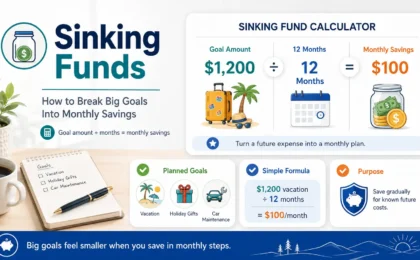
An emergency fund is for unexpected events. A sinking fund is usually for planned future expenses.
For example, if you know your car insurance premium is due in six months, that is a planned expense. If you know you want to replace a laptop next year, that is also planned. Those may be good reasons to save, but they are different from an emergency fund.
A sinking fund usually answers this question:
How much should I set aside each month for a known future cost?
An emergency fund answers a different question:
How much would I need available if something unexpected affected my essential expenses or income?
Common Emergency Fund Calculation Mistakes
Mistake 1: Including every lifestyle expense
If your goal is to estimate basic emergency coverage, include essential expenses first. Optional spending can make the target larger and harder to interpret.
Mistake 2: Forgetting irregular essential costs
Some important expenses do not happen every month. Insurance premiums, medical costs, school costs, car registration, or home maintenance may need to be considered if they are essential and predictable.
Mistake 3: Assuming one target fits everyone
A single person with stable income may think about emergency savings differently than a family with dependents, variable income, or higher essential expenses. The formula can estimate a target, but it cannot evaluate every personal detail.
Mistake 4: Treating the calculator as financial advice
The calculator is a math tool. It does not recommend a bank, investment, savings account, brokerage account, or debt decision. It only estimates a target based on essential expenses and months.
A Practical Worksheet Example
Before using the calculator, you can organize your expenses into a simple list. The goal is to estimate the monthly cost of essential items.
| Essential Expense | Monthly Estimate |
|---|---|
| Housing | $1,400 |
| Groceries | $500 |
| Utilities | $250 |
| Insurance | $200 |
| Transportation | $300 |
| Minimum required payments | $250 |
| Necessary medical costs | $100 |
| Total essential monthly expenses | $3,000 |
With $3,000 in essential monthly expenses, the emergency fund target would be:
- Three months: $3,000 × 3 = $9,000.
- Six months: $3,000 × 6 = $18,000.
This example is simplified. Your own worksheet may include different categories or different amounts.
What If the Target Number Feels Too Large?
Emergency fund targets can look large when you first calculate them. That is normal, especially when multiplying monthly expenses by several months.
The purpose of the calculator is not to create pressure. It is to make the number visible. Once the number is visible, you can understand the distance between your current emergency savings and the target estimate.
For example, if your six-month target is $18,000 and your current emergency savings is $2,000, the estimated gap is $16,000. That gap does not tell you what to do next. It simply shows the math.
Planning Snapshot
An emergency fund target is a planning number. It helps you understand scale, but it does not require you to reach the full amount immediately or follow one fixed path.
When to Recalculate Your Emergency Fund Target
Your emergency fund target can change when your essential expenses change. A number that made sense last year may not match your current budget.
You may want to recalculate after major life or budget changes, such as:
- Moving to a new home or city.
- A rent or mortgage payment change.
- A change in household income.
- Adding or removing dependents from the household budget.
- A major insurance premium change.
- A transportation change, such as buying or selling a car.
- A new recurring medical, childcare, or family expense.
Recalculating does not mean your previous number was wrong. It means your emergency fund estimate should follow your real essential expenses.
Final Takeaway
An emergency fund is a reserve for unexpected expenses or income disruptions. It is different from a planned purchase fund or a general wish list.
The core calculation is simple: estimate your essential monthly expenses, then multiply that number by three to six months or another target period you want to review.
The Emergency Fund Target Calculator helps automate that math. It can show a three-month target, a six-month target, and the difference between your current savings and your estimated goal.
Bottom line: the calculator does not make financial decisions for you. It only turns your essential monthly expenses into a clear emergency fund target number.
Next Step
Calculate your emergency fund target.
Enter your essential monthly expenses and choose a target period to estimate how much emergency savings the formula would suggest.
Open the Emergency Fund Target CalculatorFAQ
What is an emergency fund?
An emergency fund is money set aside for unexpected expenses or income disruptions. It is usually intended for urgent, unplanned needs such as medical bills, necessary repairs, or temporary loss of income.
How do I calculate an emergency fund target?
A simple emergency fund target can be calculated by multiplying essential monthly expenses by a target number of months. For example, $2,500 in essential monthly expenses multiplied by 6 months equals a $15,000 target.
What expenses should I include in an emergency fund calculation?
A basic emergency fund calculation usually focuses on essential monthly expenses, such as housing, groceries, utilities, insurance, minimum required payments, transportation, childcare, and necessary medical costs.
Is buying a TV an emergency expense?
Buying a TV is usually not considered an emergency expense because it is generally optional and can often be planned or delayed. An emergency fund is usually meant for urgent and unexpected needs.
Should I use my emergency fund to pay debt?
This article does not provide debt repayment advice. The Emergency Fund Target Calculator only estimates a savings target based on essential expenses and months. Whether to use emergency savings for debt depends on personal circumstances.
Where should I keep my emergency fund?
This article does not recommend any bank, brokerage, account, or financial product. It only explains how to calculate an emergency fund target. Account choices depend on individual needs and should be evaluated separately.
Is a three-month or six-month emergency fund better?
A three-month target and a six-month target are both common educational examples. The calculator can show both numbers, but it cannot determine which target is best for your full financial situation.
Disclaimer & Editorial Disclosure
Informational Purposes Only: This content and the attached calculators are for educational and informational purposes only. They do not constitute financial, investment, tax, legal, banking, credit, debt repayment, or career advice. All examples are hypothetical and simplified for learning purposes.
No Individual Recommendation: The Emergency Fund Target Calculator applies a basic multiplication formula to the numbers you enter. It does not evaluate your full financial situation, recommend where to keep money, suggest which debts to pay, or determine whether any financial decision is appropriate for you.
Editorial Note: Wealth Logic Hub publishes educational content and calculator-based resources. References to emergency savings concepts are provided for general information only and should not be treated as personalized financial guidance.