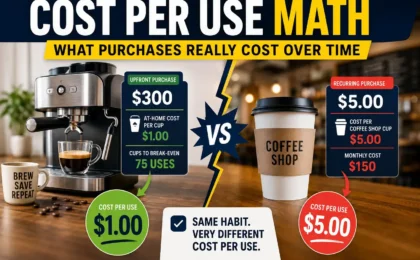
Editorial Note: This article is for educational and informational purposes only. It explains how small recurring expenses can add up over time using simple multiplication. It does not tell readers what to buy, what to cancel, or how to make personal financial decisions.
Some expenses feel small because they happen one day at a time. A coffee, a delivery fee, a snack, or a small convenience purchase may not seem important when viewed as a single transaction.
But daily expenses can become much larger when repeated over weeks, months, and a full year. This is not about guilt. It is about visibility.
For example, a $5 daily expense becomes $1,825 over one year:
- $5 × 365 days = $1,825 per year.
The point is not to say that coffee, delivery, or small purchases are bad. The point is to understand the annual cost so those expenses can fit more clearly inside a monthly budget.
This guide explains how the Daily Expense Annual Cost Calculator turns small recurring spending into a yearly estimate.
Quick Answer
Small daily expenses can become significant annual amounts because they repeat.
A $5 daily purchase equals $35 per week, about $150 per 30-day month, and $1,825 per year.
What Are Invisible Expenses?
Invisible expenses are small or routine purchases that can be easy to overlook because they do not feel large in the moment.
They are not literally invisible. They appear on a receipt, card statement, or payment history. But they may feel invisible inside a budget because each transaction is small by itself.
Common examples may include:
- Daily coffee or tea.
- Delivery fees and service charges.
- Convenience store snacks.
- Small rideshare trips.
- Impulse purchases under $10.
- Small app or digital purchases.
These expenses are not automatically wrong. A budget can include comfort, convenience, and enjoyment. The useful question is not whether the purchase is “good” or “bad.” The useful question is how much it costs when repeated.
Simple distinction: A small purchase may be easy to ignore once, but repeated purchases can become a measurable annual category.
The Basic Daily Expense Formula
The math is simple. To estimate the annual cost of a daily expense, multiply the daily amount by the number of days in a year.
Simple Math
Annual cost = daily expense × 365 days
Example: $5 per day × 365 days = $1,825 per year.
This is sometimes called the cumulative effect of spending. The amount grows not because the daily purchase changes, but because the same amount repeats many times.
The formula can also be used for weekly or monthly estimates. The calculator helps automate that math so you can quickly compare daily, weekly, monthly, and yearly totals.
A Simple Coffee Example
Assume someone spends $5 per day on coffee or another small daily purchase.
| Time Period | Calculation | Estimated Cost |
|---|---|---|
| 1 day | $5 × 1 | $5 |
| 1 week | $5 × 7 | $35 |
| 30 days | $5 × 30 | $150 |
| 1 year | $5 × 365 | $1,825 |
The yearly number may look very different from the daily number. That does not mean the purchase must stop. It means the annual total is worth seeing.
If the expense fits comfortably inside your budget, the annual number may simply confirm that you planned for it. If it does not fit, the number can help you understand the scale before making any changes.
Soft Finance Reminder
The goal is not to shame small purchases. The goal is to turn repeated spending into a visible number so it can be budgeted on purpose.
Delivery Spending Works the Same Way
Delivery spending can also feel smaller when viewed one order at a time. A delivery order may include food, tax, tip, delivery fee, service fee, and sometimes a small price difference compared with buying directly.
This article does not tell you to stop ordering delivery. Convenience can have value, and every household has different priorities.
The calculator only answers a math question:
If this expense repeats at this frequency, what does it cost over a year?
For example, assume a $25 delivery order happens twice per week.
- $25 × 2 orders per week = $50 per week.
- $50 × 52 weeks = $2,600 per year.
Again, the point is not to label the spending as wrong. The point is to make the annual amount visible.
Why Annualizing Small Expenses Helps
Annualizing means converting a daily, weekly, or monthly amount into a yearly estimate. This can be useful because many small expenses do not look meaningful until they are viewed over a longer period.
Annualizing can help you:
- See the yearly cost of a recurring habit.
- Compare small purchases with larger budget categories.
- Estimate how much convenience spending costs over time.
- Plan for enjoyable spending without guessing.
- Decide whether the amount fits your own budget.
A yearly number can feel clearer than dozens of small transactions spread across a statement. The math groups those transactions into one visible estimate.
Daily Expense Calculator
Turn a small daily expense into an annual number.
Use the Daily Expense Annual Cost Calculator to estimate how much a repeated daily, weekly, or monthly expense may cost over a full year.
Use the Daily Expense Annual Cost CalculatorHow the Daily Expense Annual Cost Calculator Works
The Daily Expense Annual Cost Calculator is designed to automate simple multiplication. You enter the cost of a recurring expense and how often it happens. The calculator estimates the annual cost.
Step 1: Enter the expense amount
This is the cost of one purchase, order, or recurring item. For example, you may enter $5 for a daily coffee or $25 for a delivery order.
Step 2: Choose the frequency
The frequency is how often the expense happens. It may be daily, weekly, monthly, or another regular pattern depending on the calculator options.
Step 3: Review the estimated annual cost
The calculator multiplies the expense by its frequency over a year. The result is an annual estimate.
Step 4: Compare the number with your budget
The result is not a command. It is a planning number. You can compare it with your monthly or yearly budget and decide whether the amount fits your priorities.
What the Calculator Cannot Tell You
The calculator cannot tell you whether a purchase is worth it, whether you should stop buying something, or how to change your budget. It only estimates the annual cost of a repeated expense.
More Examples of Small Expenses Over a Year
The table below shows how small recurring expenses can add up when repeated over a year.
| Recurring Expense | Frequency | Calculation | This Is Visibility, Not Judgment Budgeting can become unhelpful when it turns into blame. Small purchases often provide convenience, comfort, time savings, or enjoyment. Those things can matter. The purpose of annual cost math is not to remove every enjoyable expense. It is to make repeated spending visible enough to plan for it. For example, if a $5 daily coffee adds up to $1,825 per year, there are many possible reactions:
All of those responses are different from being told what to do. The calculator provides visibility. The decision stays with the user. Daily, Weekly, and Monthly ViewsOne reason invisible spending is difficult to track is that people often think in different time periods. A purchase may feel small daily but large annually. Looking at the same expense across different time frames can help:
The yearly number is often the most surprising because it combines cost and frequency into one total. How to Use This Number in a BudgetOnce you know the annual cost, you can translate it back into a monthly planning number. For example, a $1,825 yearly cost is about $152.08 per month when divided by 12:
This monthly number can be easier to compare with your budget than the daily amount. A $5 purchase may not stand out, but a $152 monthly category may be easier to see. Again, the point is not to remove the category. The point is to decide whether the category has a clear place in the budget. Budgeting Snapshot Annual cost math helps translate small purchases into a budget category. It does not decide whether that category should stay, change, or disappear. Common Mistakes When Estimating Daily ExpensesMistake 1: Only looking at one purchaseOne purchase may not show the full pattern. The annual estimate depends on how often the expense repeats. Mistake 2: Forgetting fees, tips, or taxesDelivery and convenience purchases may include extra costs. If you want a more realistic estimate, use the full amount paid, not only the menu price or item price. Mistake 3: Assuming every week looks the sameReal life is uneven. Some weeks may include more purchases, while others include fewer. A calculator estimate is useful, but it is still an estimate. Mistake 4: Treating the number as a judgmentA higher annual total does not automatically mean the expense is wrong. It simply means the expense is large enough to notice. A Simple Worksheet ExampleIf you want to prepare numbers before using the calculator, you can list a few repeated expenses and estimate their frequency.
This type of worksheet does not need to be perfect. It is only a way to identify which small expenses repeat often enough to matter in a yearly budget. When to RecalculateDaily and weekly spending patterns can change. A number that made sense six months ago may not match your current routine. You may want to recalculate when:
Recalculating does not mean you did anything wrong. It simply updates the annual estimate based on your current pattern. Final TakeawayInvisible spending is not about blame. It is about repeated purchases that are easy to miss when viewed one transaction at a time. A $5 daily expense becomes $1,825 over a year. A $25 delivery order twice per week becomes $2,600 over a year. These numbers can be useful because they make small habits easier to compare with the rest of a budget. The Daily Expense Annual Cost Calculator helps automate that math. Enter the amount, choose the frequency, and review the yearly estimate. Bottom line: the goal is not to stop enjoying small purchases. The goal is to understand their annual cost so they can be planned with more clarity. Next Step Calculate the annual cost of a small recurring expense. Enter a daily, weekly, or monthly expense to estimate how much it may add up to over a full year. Open the Daily Expense Annual Cost CalculatorFAQWhat are invisible expenses?Invisible expenses are small or routine purchases that may be easy to overlook because each transaction feels small. They become more noticeable when repeated over weeks, months, or a full year. How much does $5 a day cost in a year?A $5 daily expense costs $1,825 over a year. The calculation is $5 multiplied by 365 days. Does this mean I should stop buying coffee?No. This article does not tell you to stop buying coffee or any other item. The goal is to show the annual cost so the expense can be planned more clearly inside a budget. How do I calculate the yearly cost of delivery?Multiply the average cost of one delivery order by how often it happens over a year. For example, a $25 order twice per week equals $25 multiplied by 2, then multiplied by 52 weeks. What does a daily expense annual cost calculator do?A daily expense annual cost calculator estimates how much a recurring daily, weekly, or monthly expense may cost over a full year. It uses simple multiplication based on the amount and frequency you enter. Are small daily purchases bad for a budget?Not automatically. Small daily purchases may fit a budget if they are planned. The annual cost estimate helps make the spending visible, but it does not judge whether the purchase is worth it. Why should I annualize small expenses?Annualizing small expenses helps show the long-term total of repeated spending. A daily amount may look small, while the yearly total may be easier to compare with other budget categories. Disclaimer & Editorial Disclosure
 Related articles |
|---|