As interest rates stabilize in the 2026 market, sophisticated homeowners are shifting their focus from simple debt management to Asset-Backed Liquidity. In this environment, a Home Equity Line of Credit (HELOC) is no longer just a loan—it is a sophisticated credit architecture component that acts as a low-cost capital reserve.
1. The Strategic Edge of Home Equity
Unlike unsecured credit cards, a HELOC is anchored by your property value, allowing for significantly lower APRs and higher credit limits. In 2026, the elite strategy is to treat a HELOC as a “Standby Capital Facility”—a liquid reserve that remains untouched until a high-yield investment opportunity or a capital-intensive project arises.
2. HELOC vs. Cash-Out Refinance: The 2026 Calculus
In a stabilizing rate market, the decision between a HELOC and a traditional refinance is purely mathematical:
- The Refinance Play: Best for locking in a fixed rate for the long term when your current mortgage rate is higher than the market average.
- The HELOC Play: Superior for those who have a low-rate primary mortgage and wish to access equity without disturbing their original low-interest debt structure.
3. Integrating HELOC into your Credit Architecture
To maintain a “Gold Standard” financial profile, you must manage your HELOC with the same precision as your card sequencing:
- DTI Management: Ensure the line of credit does not over-leverage your Debt-to-Income ratio, preserving your ability to acquire Tier-1 rewards cards.
- Credit Utilization: While a HELOC is a revolving line, credit bureaus often treat it differently than cards. Strategically using a HELOC for debt consolidation can actually improve your FICO score by lowering your credit card utilization percentages.
4. Risk Mitigation and Capital Protection
Leveraging your home requires impeccable financial discipline.
- The Golden Rule: Only use equity for value-adding assets—such as home renovations that increase property value or high-yield investments—rather than lifestyle inflation.
- Liquidity Buffer: Always maintain a 20% equity cushion to protect against potential market volatility.
Conclusion
The 2026 mandate is to treat your home as more than a shelter; it is your most powerful financial tool. By integrating a HELOC into your broader credit strategy, you gain a level of liquidity and capital velocity that unsecured debt simply cannot provide.

Related articles

The 2026 Jumbo Loan Blueprint: High-Net-Worth Refinancing and Interest
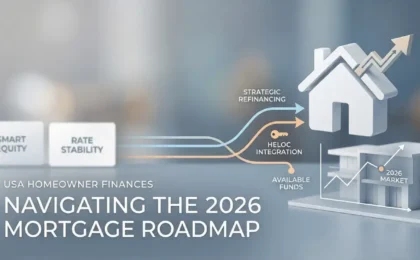
The 2026 Mortgage Roadmap: Strategic Refinancing and HELOC Integration in a Stabilizing Rate Market

Unlocking Capital: A Strategic Guide to SBA 7(a) and 504 Loans for Scaling Your Business