Educational math note: This article explains a general budgeting framework and simple payday math for educational purposes only. It does not provide financial, tax, legal, banking, debt, investment, or personalized budgeting advice.
A traditional budget often starts with tracking every category: groceries, coffee, gas, restaurants, subscriptions, household items, entertainment, and dozens of small purchases. That level of detail can be useful for some people, but it can also become tiring quickly.
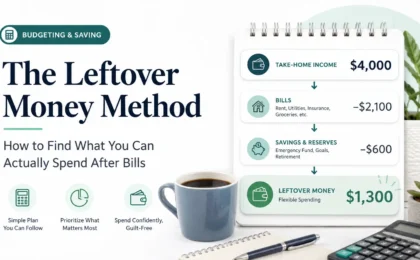
The reverse budget looks at the problem from the opposite direction. Instead of tracking every small purchase first, the method starts by setting aside money for fixed bills, planned savings, and reserve categories near payday. The remaining amount becomes the flexible spending pool for the rest of the period.
This is sometimes called the pay yourself first method. The phrase does not mean that one approach is right for every household. It simply describes the order of the math: planned categories first, flexible spending second.
Quick Answer
A reverse budget starts by subtracting savings, planned reserves, and fixed bills from take-home income first. The money left after those planned categories becomes the flexible spending amount.
The simple formula is: take-home income − planned savings − fixed bills − reserve categories = flexible spending.

What Is a Reverse Budget?
A reverse budget is a budgeting method that focuses on the first few money moves after income arrives. Instead of reviewing every transaction throughout the month, the method separates the most important planned categories early.
The basic order is:
- Start with take-home income.
- Set aside the savings or reserve amount planned for the period.
- Set aside fixed bills and required monthly costs.
- Use the remaining amount as the flexible spending pool.
This is why the method is called “reverse.” A traditional budget may begin by tracking spending and then seeing what is left. A reverse budget starts with the planned categories first and then shows what remains.
Simple distinction: A traditional budget often asks, “Where did the money go?” A reverse budget asks, “What needs to be separated first?”
The Reverse Budget Formula
The math behind a reverse budget is simple subtraction. The formula does not require a complex spreadsheet.
Reverse Budget Formula
Flexible spending = take-home income − planned savings − fixed bills − reserve categories
Example: $4,000 − $800 − $2,000 − $300 = $900 in flexible spending for the month.
Each part of the formula has a specific role:
- Take-home income: money received after taxes and regular deductions.
- Planned savings: money set aside for savings goals, emergency reserves, or planned future costs.
- Fixed bills: recurring costs such as housing, utilities, transportation, insurance, subscriptions, or required payments.
- Reserve categories: irregular costs that may not happen every month but still need a place in the budget.
- Flexible spending: the remaining amount available for variable day-to-day spending.
Use the 50/30/20 Budget Calculator to Find a Starting Split
A reverse budget still needs starting numbers. One simple way to estimate those numbers is to use a percentage framework first, then adapt the result into a payday worksheet.
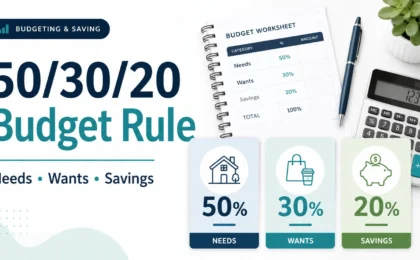
The 50/30/20 Budget Calculator divides monthly take-home income into 50% for needs, 30% for wants, and 20% for savings. In a reverse budget, the 20% savings estimate can become the “pay yourself first” line, while the needs category can help estimate fixed bills and required costs.
Related Calculator
Start with a simple percentage split.
Use the 50/30/20 Budget Calculator to estimate broad needs, wants, and savings categories before building a reverse budget worksheet.
Open the 50/30/20 Budget CalculatorExample Reverse Budget Using $4,000 Per Month
Here is a simplified example using $4,000 in monthly take-home income. The example uses the 50/30/20 framework as a starting point, then turns it into a reverse budget worksheet.
| Category | Percentage Example | Dollar Amount | Reverse Budget Role |
|---|---|---|---|
| Needs | 50% | $2,000 | Fixed bills and required costs |
| Wants | 30% | $1,200 | Flexible spending pool |
| Savings | 20% | $800 | Pay-yourself-first amount |
In this example, the reverse budget might start with the $800 savings amount. Then the fixed bills are separated. The rest becomes flexible spending.
The worksheet could look like this:
| Line Item | Example Amount | Running Balance |
|---|---|---|
| Monthly take-home income | $4,000 | $4,000 |
| Planned savings or reserves | − $800 | $3,200 |
| Fixed bills and required costs | − $2,000 | $1,200 |
| Extra irregular reserves | − $300 | $900 |
| Flexible spending for the month | $900 |
This table does not tell a household what its numbers should be. It only shows the order of the calculation.
Payday Worksheet: The Reverse Budget in 10 Minutes
The reverse budget is easiest to understand as a payday worksheet. The worksheet has only a few rows because the goal is not to track every purchase. The goal is to separate planned categories before the rest of the money is used.
| Payday Step | Question | Example |
|---|---|---|
| 1. Income received | How much arrived this pay period? | $2,000 |
| 2. Savings/reserve transfer | What amount is planned first? | $400 |
| 3. Bills due before next paycheck | Which fixed costs need to be covered? | $950 |
| 4. Irregular reserve | What non-monthly cost needs a small allocation? | $150 |
| 5. Flexible spending left | What remains until the next paycheck? | $500 |
This worksheet can be repeated for each paycheck. A monthly version works for monthly income. A biweekly version works for two-paycheck or three-paycheck months.
Reverse Budget vs. Traditional Budget
The main difference between a reverse budget and a traditional budget is the level of tracking. A traditional budget may assign every dollar to a category and then monitor spending closely. A reverse budget focuses more heavily on what happens at the start.
| Budgeting Method | Main Focus | Common Tradeoff |
|---|---|---|
| Traditional budget | Tracks many categories throughout the month | More detail, more maintenance |
| Reverse budget | Separates savings and bills first | Less detail, more reliance on the starting split |
| 50/30/20 budget | Uses broad percentage categories | Simple structure, but may not fit every household |
None of these methods is automatically better. They are different ways to organize the same basic math.
What Counts as “Pay Yourself First”?
In a reverse budget, “pay yourself first” usually means separating money for future-focused categories before flexible spending begins. The categories can vary by household and by purpose.
Examples can include:
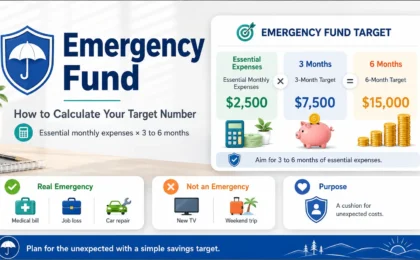
- emergency savings;
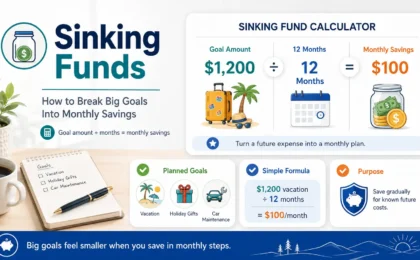
- planned reserves for annual bills;
- future car repair costs;
- holiday spending reserves;
- moving costs;
- school supplies;
- travel savings;
- home maintenance reserves;
- extra payments above required minimums.
The key feature is not the account type, product, or provider. The key feature is the math order: the planned amount is separated before flexible spending is calculated.
A Simple Monthly Reverse Budget Table
A reverse budget can be organized with one small monthly table. The table below uses broad categories instead of detailed transaction tracking.
| Monthly Category | Example Amount | Timing |
|---|---|---|
| Take-home income | $4,000 | When income arrives |
| Planned savings/reserves | $800 | Same day or early in the period |
| Fixed bills | $2,000 | Scheduled by due date |
| Irregular cost reserves | $300 | Early in the period |
| Flexible spending pool | $900 | Rest of the month |
This structure is simple because it does not require every small spending category to be predicted in advance. The flexible pool absorbs smaller variable purchases.
Why Reverse Budgeting Can Feel Simpler
Reverse budgeting can feel simpler because the important categories are handled early. After that, the flexible spending number becomes easier to see.
For example, a person may not want to track every coffee, snack, or small purchase. A reverse budget does not eliminate the need to understand spending, but it can reduce the number of categories being watched every day.
The method works best as a visibility tool. It answers one question clearly:
After planned savings, fixed bills, and reserves are separated, how much flexible money remains?
Common Blind Spots in a Reverse Budget
A reverse budget can become misleading if important costs are left out. The flexible spending pool may look larger than it really is when irregular expenses are ignored.
Blind Spot Snapshot
The flexible spending number only works if fixed bills, planned reserves, and irregular costs are included first. Annual bills, repairs, school costs, gifts, and seasonal expenses can make the leftover number look too high if they are missing.
Commonly missed categories can include:
- annual subscriptions;
- car registration or inspection costs;
- insurance payments that do not bill monthly;
- school supplies or activity fees;
- holiday gifts;
- medical or dental copays;
- home or car repairs;
- pet care;
- seasonal utility changes.
When a Reverse Budget May Not Be Enough
A reverse budget is intentionally simple. That simplicity is useful, but it also creates limits.
The method may be incomplete when:
- income changes often;
- bills are behind or irregular;
- required expenses are higher than income;
- cash flow is tight between paychecks;
- annual bills are not already planned;
- the flexible spending pool regularly runs out early.
In those cases, a more detailed category budget may provide clearer information. The reverse budget is a framework for simplifying the order of the math, not a complete solution for every situation.
Reverse Budgeting Without a Spreadsheet
A reverse budget can be built with a short note, a banking app memo, a calculator, or a simple table. The important part is not the tool. The important part is the order of the calculation.
A minimal version only needs four numbers:
- take-home income;
- planned savings or reserve amount;
- fixed bills and required costs;
- remaining flexible spending.
The full worksheet can be as simple as this:
| Reverse Budget Line | Your Number |
|---|---|
| Monthly take-home income | |
| Planned savings/reserves | |
| Fixed bills | |
| Irregular cost reserves | |
| Flexible spending left |
What This Article Cannot Tell You
This article explains the reverse budget as a general math framework. It cannot decide whether a specific savings rate, bill schedule, spending amount, account setup, or budgeting method is appropriate for any household.
It does not decide:
- how much any person should save;
- which account, bank, app, or provider to use;
- whether a household should change spending;
- whether a debt payment strategy is appropriate;
- whether a specific budget split is realistic;
- how to handle legal, tax, credit, lending, or investment decisions.
The purpose is only to show how the numbers can be organized.
The Bottom Line
The reverse budget is a simple way to organize payday math. It starts by separating planned savings, fixed bills, and reserve categories before calculating flexible spending.
The method can reduce the need to track every small purchase because the most important categories are handled first. The remaining number becomes the flexible spending pool for the rest of the month or pay period.
A percentage tool such as the 50/30/20 Budget Calculator can help create a starting split. From there, the reverse budget formula turns that split into a practical worksheet: income minus planned savings, fixed bills, and reserves equals flexible spending.
FAQ
What is a reverse budget?
A reverse budget is a budgeting method that separates planned savings, fixed bills, and reserve categories first. The remaining money becomes the flexible spending pool for the rest of the month or pay period.
What does pay yourself first mean?
Pay yourself first usually means setting aside money for savings, reserves, or future goals before calculating flexible spending. In this article, the phrase describes the order of the math, not a personalized recommendation.
How do you calculate a reverse budget?
The basic formula is: flexible spending equals take-home income minus planned savings, fixed bills, and reserve categories.
Is a reverse budget the same as the 50/30/20 rule?
No. The 50/30/20 rule is a percentage framework that splits income into needs, wants, and savings. A reverse budget is an order-of-operations method that separates planned categories first and leaves the rest for flexible spending.
Does a reverse budget require a spreadsheet?
No. A reverse budget can be organized with a small worksheet, a calculator, a note, or a simple table. The main calculation is basic subtraction.
What are the limits of reverse budgeting?
A reverse budget may be incomplete if income is irregular, bills are behind, required expenses exceed income, or irregular costs are not included. In those cases, a more detailed budget may show more useful information.
Disclaimer & Editorial Disclosure
Educational Purposes Only: This content is for educational and informational purposes only. It explains a general budgeting framework and simple arithmetic. It does not constitute financial, investment, tax, legal, banking, credit, lending, debt, employment, or professional advice.
No Individual Recommendation: The reverse budget examples in this article do not determine how much any person should save, spend, transfer, reserve, or allocate. Actual household budgets vary by income, expenses, bills, family size, location, timing, and personal circumstances.
Editorial Note: Wealth Logic Hub publishes educational content about everyday math, budgeting visibility, and calculator-based learning. References to reverse budgeting, pay-yourself-first methods, savings categories, fixed bills, and flexible spending are provided for general information only.