Editorial Note: This article is for educational and informational purposes only. It explains a simple way to divide a future goal into smaller monthly savings amounts. It does not recommend any bank, brokerage, investment, account, financial product, or high-risk strategy.
A sinking fund is a simple way to prepare for a future expense by breaking one large amount into smaller monthly pieces.
Instead of waiting until a big bill, trip, repair, or purchase arrives, you estimate the total cost first. Then you divide that cost by the number of months available before the money is needed.
For example, if you want to set aside $1,200 for a vacation 12 months from now, the basic math is simple:
- $1,200 ÷ 12 months = $100 per month.
This guide does not promise that every goal will be reached, and it does not suggest using investments or high-risk strategies to speed up the process. It only explains how to use a simple monthly savings formula with the Sinking Fund Calculator.
Quick Answer
A sinking fund divides a future cost into smaller monthly savings amounts.
The basic formula is: future goal amount ÷ months until the goal = monthly savings amount.
What Is a Sinking Fund?
A sinking fund is money set aside gradually for a known or expected future expense. The expense may not be due today, but it is something you can reasonably plan for.
Common sinking fund examples include:
- A vacation planned for next year.
- Holiday gifts.
- Annual insurance premiums.
- Car maintenance.
- Back-to-school costs.
- Furniture replacement.
- A planned home project.
The idea is not complicated. A sinking fund turns a large future amount into a smaller monthly amount that is easier to see inside a budget.
Simple definition: A sinking fund is a planned savings bucket for a future expense that has a target amount and a timeline.
The Basic Sinking Fund Formula
The simplest sinking fund formula is:
Simple Math
Monthly savings amount = future goal amount ÷ number of months
Example: $1,200 vacation goal ÷ 12 months = $100 per month.
This formula is useful because it removes the guesswork from a future expense. Instead of saying “I need to save for this someday,” the math gives you a specific monthly estimate.
The formula has two main inputs:
- Target amount: the estimated cost of the future goal.
- Timeline: the number of months until the money is needed.
Once you know those two numbers, the calculator can estimate the monthly amount for you.
A Simple Sinking Fund Example
Assume you want to set aside $1,200 for a vacation 12 months from now.
| Input | Amount |
|---|---|
| Future goal | Vacation |
| Estimated cost | $1,200 |
| Time available | 12 months |
| Monthly savings estimate | $100 per month |
The calculation is:
- $1,200 ÷ 12 = $100.
In this simplified example, the sinking fund target is $100 per month. The calculator does the same type of math for any goal amount and timeline you enter.
Soft Finance Reminder
A sinking fund is not a promise that a goal will happen exactly as planned. It is a planning number that helps you understand how a future cost could fit into a monthly budget.
Why Sinking Funds Can Make Big Goals Feel Smaller
Large expenses can feel difficult when viewed as one total number. A $1,200 goal may look heavy if it is due all at once. But the same goal may feel easier to understand when divided across 12 months.
The sinking fund method changes the question from:
How will I come up with $1,200 later?
to:
What monthly amount would add up to $1,200 by that date?
This is the main benefit of the method. It turns a future cost into a monthly planning number.
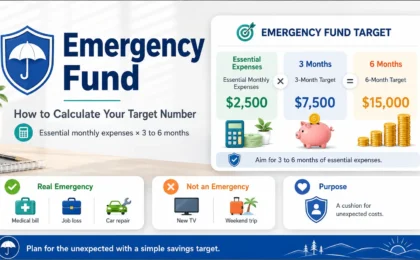
Sinking Fund vs. Emergency Fund
A sinking fund is not the same as an emergency fund.
A sinking fund is usually for a planned or expected future expense. An emergency fund is usually for unexpected expenses or income disruptions.
| Type of Fund | Main Purpose | Example |
|---|---|---|
| Sinking fund | Known or expected future cost | $1,200 vacation in 12 months |
| Emergency fund | Unexpected expense or income disruption | Urgent car repair or temporary job loss |
Both concepts use savings, but they answer different questions. A sinking fund asks how much to set aside for a known future cost. An emergency fund asks how much cushion may be needed for an unexpected event.
What Kinds of Goals Work Well With Sinking Funds?
Sinking funds work best when the goal has an estimated cost and a rough timeline. The more specific those two numbers are, the easier the math becomes.
Examples may include:
- Vacation: $1,200 in 12 months.
- Holiday gifts: $900 in 9 months.
- Car maintenance: $600 in 6 months.
- Annual insurance premium: $1,500 in 10 months.
- Furniture replacement: $800 in 8 months.
- School costs: $500 in 5 months.
These examples are only for illustration. The sinking fund formula can be used with any planned goal that has a target amount and a timeline.
Sinking Fund Calculator
Break a future goal into a monthly savings amount.
Use the Sinking Fund Calculator to divide your target amount by the number of months available before the goal.
Use the Sinking Fund CalculatorHow the Sinking Fund Calculator Works
The Sinking Fund Calculator automates the division step. Instead of doing the math by hand for every goal, you enter the target amount and the number of months.
Step 1: Enter the future goal amount
This is the estimated total cost of the goal. For example, you may enter $1,200 for a planned trip, $600 for car maintenance, or $900 for holiday expenses.
Step 2: Enter the number of months
This is the amount of time available before the goal arrives. For example, a cost due one year from now would use 12 months.
Step 3: Review the monthly amount
The calculator divides the goal amount by the number of months. The result is the estimated monthly savings amount.
Step 4: Compare the amount with your budget
The result is a planning number. You can compare it with your current monthly budget to see how the future goal might fit.
What the Calculator Cannot Tell You
The calculator cannot tell you whether a goal is affordable, whether you should change your spending, where to keep the money, or whether to use investments. It only divides a goal amount by a timeline.
Example Sinking Fund Targets
The table below shows how different goals can be divided into monthly savings amounts.
| Goal | Target Amount | Months Available | Monthly Amount |
|---|---|---|---|
| Vacation | $1,200 | 12 | $100 |
| Car maintenance | $600 | 6 | $100 |
| Holiday gifts | $900 | 9 | $100 |
| Furniture replacement | $800 | 8 | $100 |
| Annual insurance premium | $1,500 | 10 | $150 |
These examples use rounded numbers to make the math easy to follow. Real goals may have uneven costs, changing prices, or a timeline that changes over time.
What If the Monthly Amount Feels Too High?
Sometimes the monthly amount may be higher than expected. That does not mean the calculator is wrong. It means the target amount, timeline, and monthly budget may not fit together easily.
For example, a $2,400 goal due in 6 months requires $400 per month:
- $2,400 ÷ 6 = $400 per month.
The calculator does not decide what to change. It only shows the relationship between the target amount and the timeline.
In general, there are only a few variables in the formula:
- The target amount.
- The number of months.
- The monthly savings amount.
Changing one of those variables changes the result. A longer timeline usually lowers the monthly amount. A larger target usually raises it.
Planning note: This article does not recommend changing a goal, delaying a purchase, or choosing one expense over another. It only explains the math behind the monthly savings estimate.
Why This Method Avoids Guessing
Without a formula, a future goal can feel vague. You may know the goal matters, but not know what it means for your monthly budget.
A sinking fund makes the goal more specific. It gives the future cost a monthly number.
For example, “save for holiday gifts” is vague. “Set aside $100 per month for 9 months toward a $900 holiday gift goal” is clearer.
This clarity is the main purpose of the sinking fund method. It does not need complex financial forecasting. It only needs a target amount and a timeline.
Sinking Funds and Monthly Budget Planning
A sinking fund can be useful because it turns irregular expenses into monthly planning items. Many budgets feel fine during normal months but become stressful when a larger planned expense appears.
Examples include annual premiums, school expenses, holiday costs, and seasonal travel. These expenses may not happen every month, but they can still be expected.
By dividing the cost over time, you can see the monthly impact before the due date arrives.
Planning Snapshot
A sinking fund does not remove the cost of a goal. It spreads the cost across the months available, making the goal easier to compare with the rest of your budget.
Common Sinking Fund Mistakes
Mistake 1: Guessing the monthly amount
Guessing can make a future goal unclear. A calculator gives you a direct estimate based on the target amount and timeline.
Mistake 2: Forgetting the due date
The number of months matters. A $1,200 goal in 12 months requires $100 per month. The same $1,200 goal in 6 months requires $200 per month.
Mistake 3: Mixing planned goals with emergencies
A planned vacation, annual bill, or holiday expense is usually different from an emergency. Keeping the concepts separate can make the math easier to understand.
Mistake 4: Assuming growth or investment returns
This simplified sinking fund method does not rely on investment returns, market performance, or high-risk strategies. It focuses only on dividing the goal amount by the time available.
A Larger Example: $3,000 in 18 Months
Assume a planned home project is estimated to cost $3,000 and the target date is 18 months away.
The calculation is:
- $3,000 ÷ 18 = $166.67 per month.
In this example, the monthly sinking fund estimate is about $166.67 per month.
The number may be rounded depending on how you prefer to plan. For example, some people may round up to make the monthly amount easier to track, but the calculator itself simply shows the math.
When to Recalculate a Sinking Fund
A sinking fund target can change if the goal amount or timeline changes.
You may want to recalculate when:
- The estimated cost changes.
- The deadline moves closer or farther away.
- You add money to the goal ahead of schedule.
- You decide to track a different target amount.
- The goal becomes more specific after research or planning.
Recalculating does not mean the original plan failed. It simply means the numbers changed.
Final Takeaway
A sinking fund is a simple way to turn a future cost into a monthly savings estimate.
The formula is easy: divide the total goal amount by the number of months available. A $1,200 goal in 12 months becomes $100 per month.
The Sinking Fund Calculator helps automate that calculation. It can show how much a future goal may require each month based on the target amount and timeline you enter.
Bottom line: a sinking fund does not predict the future or guarantee a result. It simply makes a future expense easier to understand by converting it into a monthly number.
Next Step
Calculate your monthly sinking fund amount.
Enter your future goal amount and the number of months available to estimate the monthly savings amount.
Open the Sinking Fund CalculatorFAQ
What is a sinking fund?
A sinking fund is money set aside gradually for a known or expected future expense. It breaks one larger target amount into smaller monthly savings amounts based on the timeline.
How do I calculate a sinking fund?
A simple sinking fund calculation divides the future goal amount by the number of months available. For example, a $1,200 goal in 12 months equals $100 per month.
What is a sinking fund used for?
A sinking fund is often used for planned expenses such as vacations, holiday gifts, annual bills, car maintenance, school costs, furniture replacement, or home projects.
Is a sinking fund the same as an emergency fund?
No. A sinking fund is usually for a planned or expected future expense. An emergency fund is usually for unexpected expenses or income disruptions.
Does a sinking fund require investing?
No. This simplified sinking fund method does not rely on investing, market returns, or high-risk strategies. It focuses only on dividing a goal amount by the time available.
What if my monthly sinking fund amount is too high?
If the monthly amount feels too high, the calculator is showing the relationship between the goal amount and the timeline. It does not decide what to change or whether the goal is affordable.
Can I use a sinking fund calculator for multiple goals?
Yes. You can calculate each goal separately by entering a target amount and timeline for each one. The calculator provides a monthly estimate for the numbers you enter.
Disclaimer & Editorial Disclosure
Informational Purposes Only: This content and the attached calculators are for educational and informational purposes only. They do not constitute financial, investment, tax, legal, banking, credit, debt repayment, or career advice. All examples are hypothetical and simplified for learning purposes.
No Individual Recommendation: The Sinking Fund Calculator applies a basic division formula to the numbers you enter. It does not evaluate your full financial situation, recommend where to keep money, suggest investments, or determine whether any goal or purchase is appropriate for you.
Editorial Note: Wealth Logic Hub publishes educational content and calculator-based resources. References to sinking funds and savings goals are provided for general information only and should not be treated as personalized financial guidance.